

Laser cladding falls into the group of processes commonly known as hard-facing.
The laser cladding process is a method of applying a fully dense, metallurgically bonded and virtually pure coating which can be used to increase the wear resistance, corrosion resistance or impact performance of metallic components.
In some cases, all three of the properties can be improved. The process utilises a precisely focused high power laser beam to create a weld pool into which a metallic powder is applied.
The powder, which is carried by a stream of inert shielding gas, is blown co-axially through the laser beam. The highly accurate nature of the laser beam allows fully dense cladding with minimal dilution (<5%), yet with a perfect metallurgical bond.
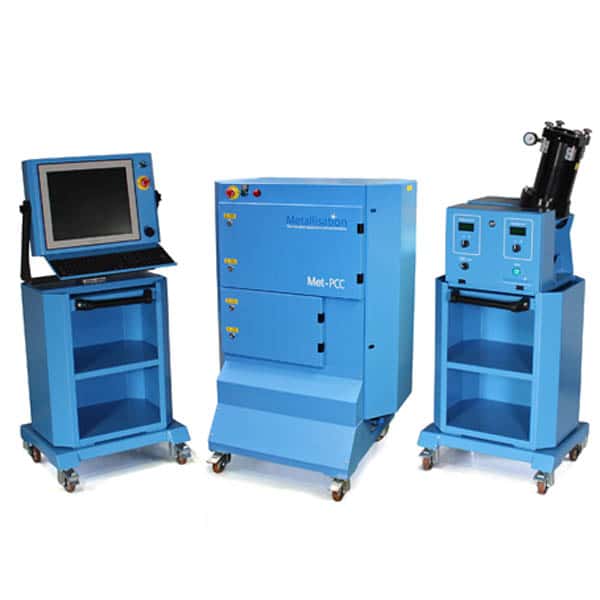
The Metallisation MET-CLAD system offers control and integration of the entire cladding process. The system offers control of the process gases, cooling system, laser, powder feed and automation interface safely via an intuitive, touch-screen interface.
These are two distinct processes that utilise a laser as the primary heat source, but they serve different purposes. Laser welding is focused on joining materials together with a high strength bond, while laser cladding adds a new material layer onto a surface for enhancement or repair purposes.
Yes. Laser cladding deposits a narrow, controlled weld bead, which allows for the very precise deposition of material onto the substrate. This makes it ideal for repairing damaged parts or delicate components.
Laser cladding is typically only possible with metals and alloys, and is not suitable for depositing ceramics or polymers.
The thickness of a single layer can range from a few micrometres (µm) to about 2 millimetres (mm). For most applications, the coating thickness falls within the range of 0.2 mm to 1.5 mm per layer.