

Thermal Barrier Coatings Onto Exhausts Systems
Thermal Barrier Coating (TBCs) are ceramic materials which are widely used on modern aero engines and land based turbines.
They can also be applied to vehicle exhausts, turbocharger casings, heat shields and other vehicle components to reduce heat transfer and improve vehicle performance. Heat soak from hot exhaust systems transfers into other vehicle components causing reduced performance or damage.
The Benefits
Thermal Barrier Coatings (TBCs) are applied in motorsport and on high-performance vehicles to reduce heat soak. TBCs retain the heat in the exhaust system which reduces under bonnet temperatures, as well as keeping the heat energy in the exhaust gas which improves the thermodynamic performance of the turbocharger. Both effects enable more power to be produced but also bolster the vehicle’s reliability.
How to Apply
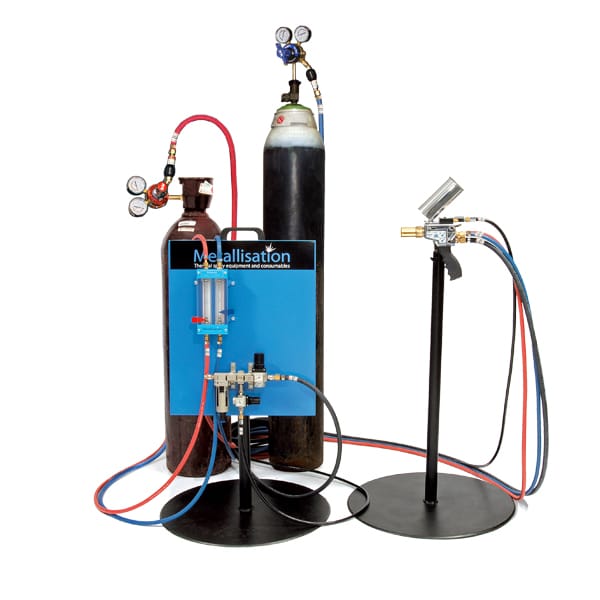
Thermal Barrier Coatings can be applied with our MK74 Powder Pistol. This handheld spray gun delivers the powder through a small gravity fed hopper, mounted on the gun itself or through a separate powder feeder (2007MF-PF). Fully automated versions of the MK74 are also available.
Thermal Barrier Coating Process
The Thermal Barrier Coating is typically a two part process with a bond coat of Ni/Al or Ni/Cr type layer and a top coat of a suitable ceramic.
Powder flame applied Thermal Barrier Coating’s are an excellent solution for the majority of exhaust related applications. However, for extreme performance applications, thermal barrier coatings can also be applied by the plasma spraying process, producing coatings that are denser and with higher bond strengths than with powder flame spray.

Materials
Bond Coat
99815
Self-bonding, high bond strength, low shrink Powder, service temp ≤ 980 °C (1796°F)
99636
Self-bonding, high bond strength, low shrink Powder, service temp ≤ 800 °C (1472°F)
99627
Self-bonding, high bond strength, low shrink Powder, service temp ≤ 650 °C (1200°F)
Top Coat
99220, 99255
Ceramic Powders used as a thermal barriers.
99205, 99216 or 99275
will give the best TBC properties.
99275
Typical coating Thermal Conductivity properties can be up to 1.0 – 1.5 W/mK
Typical Colours
99220 – Dark Blue – Service Temperature ≤ 540 °C (1000°F)
99255 – White – Service Temperature ≤ 1650 °C (3000°F)
99205 – Light Grey – Service Temperature ≤ 1100 °C (2010°F)
99216 – Grey – Service Temperature ≤ 540 °C (1000°F)
99275 – Creamy White – Service Temperature ≤ 900 °C (1650°F)
Thermal Coating Process onto Exhaust Systems
Preparation: The exhaust should be clean and free from any grease or oil.
Degreasing – Any approved industrial solvent may be used to completely remove grease or oil from the surface.
It is normal to grit blast the components surface prior to applying the coating system; this is to produce the ideal receptive surface.
Blasting – The standard of surface cleanliness required is as Swedish Standard SA3. Surfaces not being treated should be masked before blasting.
Application
Spraying should begin as soon as possible after preparation and before any visible sign of deterioration occurs.
(A) The Flame Spray Equipment should be set up in accordance with the Metallisation manual for spraying each of the flame spray materials.
(B) The area to be sprayed should be cleaned with a vacuum cleaner or clean air blast to remove any loose particles of grit.
(C) The Flame Spray pistol should be set so that the spray stream is at 90° to the surface being coated and traversed at an even speed giving a uniform coating.
(D) Apply each of the coatings to the required thickness.
Spraying Parameters

There should be the minimum of interruption from commencement of preparation to completion of spraying. At all times, the prepared surface should be protected from dust, dirt, moisture etc.
Finishing
No finishing required, component to be used in the As-Sprayed condition.
If a colour is required on the exhaust system then the application of high temperature silica ceramic coating (paint) can be applied.
REFERENCE TECHNICAL BULLETIN No :-
Metallisation 99815/12 Nickel Chrome 80/20 Powder
Metallisation 99627/16 Nickel Aluminium Moly Powder
Metallisation 99636/16 Nickel Aluminium Powder
Metallisation 99205/32 Grey Alumina 91% Powder
Metallisation 99216/32 Aluminium Oxide 87% Titanium Dioxide 13%Powder
Metallisation 99255/32 White Alumina Powder
Metallisation 99220/32 Aluminium Oxide 60% Titanium Dioxide 40%.Powder
Metallisation 99275/32 Magnesium Zirconate Powder